




Discover Bengal · Unfolded
❦Indira Gandhi
Prime Minister of India who supported Bangladesh's liberation in 1971
Indira Gandhi connected India's refugee relief, diplomacy, and December 1971 military intervention to the wider international crisis created by Bangladesh's liberation struggle.
Biography
Context
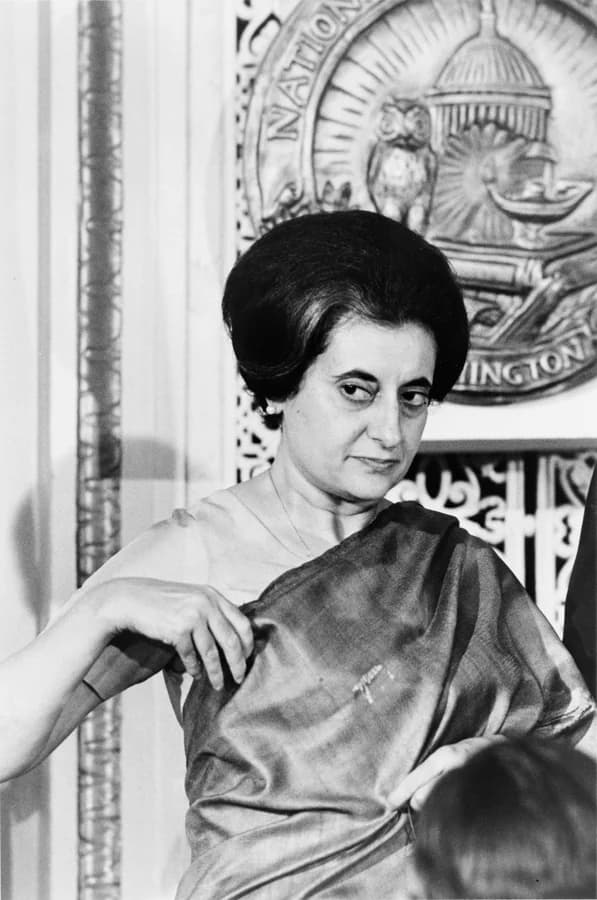
In the context of India's involvement developed in response to the March 1971 military crackdown, the formation of the Mujibnagar Government, and the arrival of millions of refugees in West Bengal and other border states. Gandhi's policy combined humanitarian relief, international advocacy, and strategic preparation; Bangladesh's liberation remained the result of the Bengali people's own mass movement and armed struggle, not an Indian-created event., Indira Gandhi is recognized as Prime Minister of India who supported Bangladesh's liberation in 1971. Indira Gandhi connected India's refugee relief, diplomacy, and December 1971 military intervention to the wider international crisis created by Bangladesh's liberation struggle.
Contribution
As India's Prime Minister in 1971, Indira Gandhi gave political support to the Bengali struggle for independence, opened India's border to refugees fleeing the Pakistan Army's violence, and backed assistance and training for the Mukti Bahini. Her government also carried the crisis into international diplomacy as the refugee burden and repression grew.
Impact
After Pakistan's attack on India in December 1971, Indian forces entered the war alongside the Bangladesh Forces and contributed to the defeat and surrender of Pakistani forces on 16 December. Gandhi's leadership helped transform a regional humanitarian and political crisis into coordinated interstate action, while also shaping the difficult post-war questions of refugees, prisoners of war, and recognition.
Timeline Placement
Indira Gandhi appears in 1 linked timeline events, spanning 1971.
First Appearance
1971
Latest Appearance
1971
Active Span
1971
Linked Events
1
Legacy Summary
After Pakistan's attack on India in December 1971, Indian forces entered the war alongside the Bangladesh Forces and contributed to the defeat and surrender of Pakistani forces on 16 December. Gandhi's leadership helped transform a regional humanitarian and political crisis into coordinated interstate action, while also shaping the difficult post-war questions of refugees, prisoners of war, and recognition. This influence is reflected across 1 connected events.
References
Key sources for understanding this figure
1971
A mega-documentary on the Bangladesh Liberation War, valuable as a broad visual archive of the year 1971.
Cited in: 1 events
1971: A Global History of the Creation of Bangladesh
Global perspective on the war across India, Pakistan, the U.S., USSR, and China.
Cited in: 1 events
1971: Inside and Outside
A post-1971 reflection on the war and its internal experience and political observation.
Cited in: 1 events
A History of Bangladesh
A synthetic history of Bangladesh from the long view through colonial encounters, East Pakistan, war, and independence.
Cited in: 1 events
A Tale of Millions: Bangladesh Liberation War 1971
A memoir-style account of the Liberation War from the perspective of a freedom fighter and military officer.
Cited in: 1 events
Achin Pakhi / The Unknown Bard
A documentary on the Bauls and Lalon’s world of folk-spiritual culture, useful for Bengali cultural history.
Cited in: 1 events
Related
Related Figures
A S M Abdur Rab
Student leader and 1971 flag-raising figure
A. A. K. Niazi
Commander of Pakistan's Eastern Command during the Bangladesh Liberation War
A. H. M. Qamaruzzaman
Home affairs leader in the Provisional Government
A. T. M. Haider
Sector Commander (Sector 2, later phase)
Abdul Halim Chowdhury
Academic and Martyred Intellectual
Abdul Jabbar
Patriotic Singer