




Discover Bengal · Unfolded
❦Khwaja Salimullah
Nawab of Dhaka and Muslim political patron
A Dhaka-based patron whose networks connected the 1905 partition to early Muslim League politics.
Biography
Context
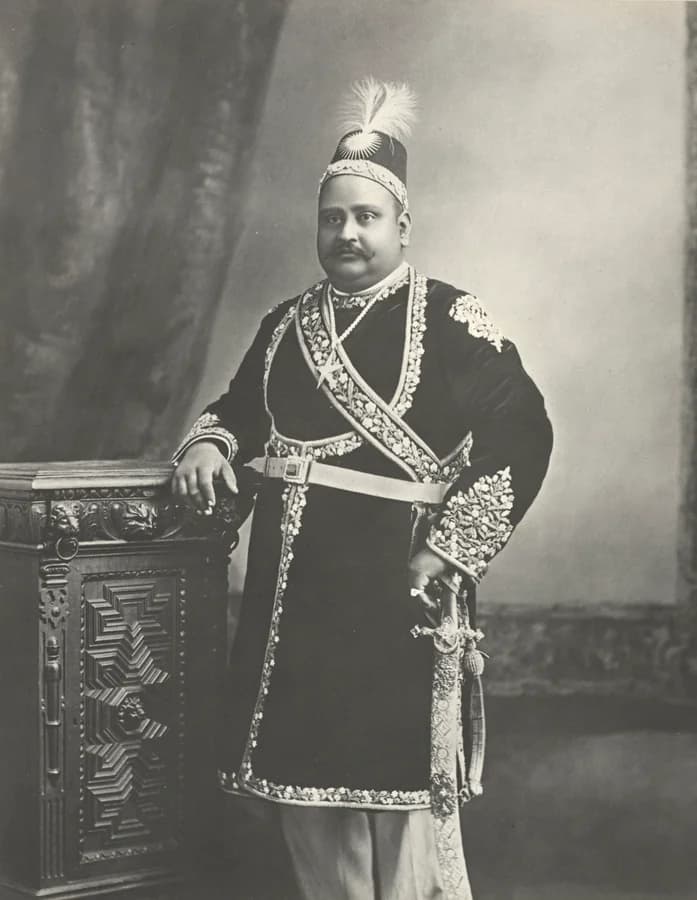
In the context of Early twentieth-century Bengal, when elite Muslim politics, education patronage, separate representation debates, and anti-partition mobilization reshaped colonial public life., Khwaja Salimullah is recognized as Nawab of Dhaka and Muslim political patron. A Dhaka-based patron whose networks connected the 1905 partition to early Muslim League politics.
Contribution
Khwaja Salimullah supported the 1905 partition of Bengal, used the Dhaka Nawab family's networks to organize Muslim political opinion, and became closely associated with the 1906 founding context of the All-India Muslim League in Dhaka.
Impact
His patronage helped make Dhaka a major center of Muslim political organization, leaving a legacy tied to the Muslim League, the politics of separate electorates, and later partition-era debates.
Timeline Placement
Khwaja Salimullah appears in 2 linked timeline events, spanning 1905 - 1906.
First Appearance
1905
Latest Appearance
1906
Active Span
1905 - 1906
Linked Events
2
Legacy Summary
His patronage helped make Dhaka a major center of Muslim political organization, leaving a legacy tied to the Muslim League, the politics of separate electorates, and later partition-era debates. This influence is reflected across 2 connected events.
References
Key sources for understanding this figure
A Case Study of Swadeshi Bengal
A classic study for the local dynamics of the Swadeshi upsurge and the way nationalist thought crystallized in Bengal.
Cited in: 2 events
And Swadeshi Movement in Bengal (1905)
Useful for trade, industry, agriculture, boycott politics, and the economic reach of the Swadeshi upsurge.
Cited in: 2 events
Partition Politics
A Bengal-centered reference entry on the politics, contradictions, and communal dynamics that produced partition.
Cited in: 2 events
Partition, Agitation and Congress: Bengal 1904 to 1908
Best for Congress politics, agitation networks, and the way anti-partition mobilization evolved across Bengal.
Cited in: 2 events
The Case of the Partition of Bengal 1905
Strong for the political background of the 1905 partition and the immediate reactions to the reorganization.
Cited in: 2 events
Through the looking glass: An analysis of the Swadeshi Movement through the indigenous Thakurmar Jhuli
Useful for Muslim perspectives and East Bengal responses, especially where Swadeshi is read through cultural memory and social boundary-making.
Cited in: 2 events
Related
Related Figures
Indian National Congress
Political Party in British India
Nawab Abdul Latif
Muslim education reform advocate in Bengal
Syed Ameer Ali
Jurist and Muslim political intellectual
Abul Hashim
Bengal Muslim League Organizer
Abul Kalam Azad
Muslim scholar-politician of anti-colonial India
All-India Muslim League
Political Party in British India
Related Places
Appears In Events
Timeline View