




Discover Bengal · Unfolded
❦Jagadish Chandra Bose
Physicist, plant physiologist, and scientific investigator
Jagadish Chandra Bose connected experimental physics and plant physiology while building a modern scientific culture in Bengal.
Biography
Context
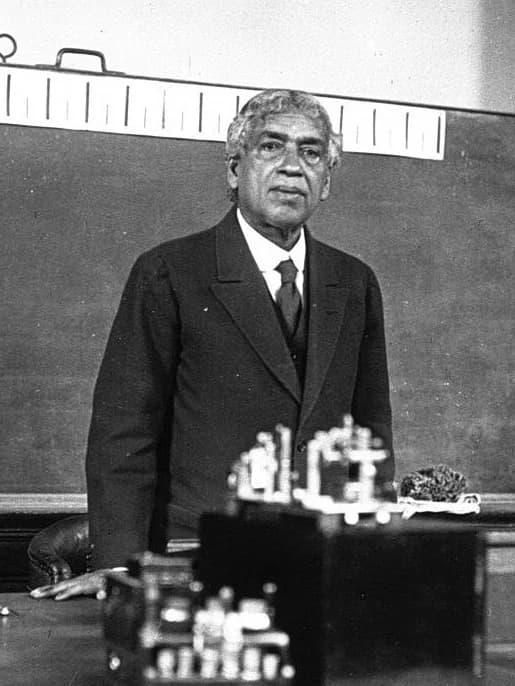
In the context of Born in Mymensingh in 1858, Bose grew up with early schooling in rural Faridpur before studying in Calcutta and at Cambridge. He returned to teach physics at Presidency College, where he researched the optical behaviour of electrical waves, including reflection, refraction, polarisation, and diffraction. From the late 1890s he turned increasingly toward responses in living and non-living matter, later using instruments such as the crescograph to measure plant movement and growth., Jagadish Chandra Bose is recognized as Physicist, plant physiologist, and scientific investigator. Jagadish Chandra Bose connected experimental physics and plant physiology while building a modern scientific culture in Bengal.
Contribution
Jagadish Chandra Bose pioneered experiments on electromagnetic waves and later developed instruments to study electrical and physiological responses in plants and other materials. His work joined experimental physics with plant physiology and helped make original scientific research part of Bengal's public intellectual life.
Impact
Bose's research connected Bengal to international scientific exchange while challenging the boundaries between physics, biology, and physiology. In 1917 he founded the Bose Institute in Calcutta as a centre for research, and his writings and public lectures helped establish a scientific culture rooted in Bengal. His legacy is best understood through his experimental instruments, institutions, and cross-disciplinary methods rather than through claims that he single-handedly invented modern radio or plant communication.